Thursday, December 15, 2016

Voodoo, School Children and a Chief’s Welcome in Lomé, Togo

In Togo, we really felt like we were experiencing the life of the African people. We started in the fetish market. It seemed pretty genuine and not a tourist show. Loved the skulls, birds, skins and phallic symbols. You’ll be glad to know that social responsibility is alive and well in Togo. The place was loaded with dead animal parts and the tour guide had the nerve to tell us not one animal had been killed for sale in the market. They were all just found dead.

We rode out into the countryside to visit a school. Education is free from K-6; not sure how many children go on to higher education. Classrooms are filled with children at simple wooden tables. Again, I kicked myself for not bringing ballpoint pens. This is what the children asked for.


Our last stop was a village where we got the welcome ceremony. They let us roam freely to see how the people live. This was the best part of the stop. Couldn’t help but chuckle at the baby goat curled up asleep in one doorway,  just like a cat or dog.


Monday, December 12, 2016

Culinary Magic in Sao Tome


Who would have thought we would find culinary magic in one of the most little known countries in Africa. Sao Tome is two small islands just north of the Equator, off the coast of Liberia. The people here are Portugese speaking and very poor. Cocao and coffee are the major crops.


Our seven-hour tour led us to an old plantation house, owned by Chef João Carlos Silva who has a television show in Portugal. Oh, my, what an incredible culinary adventure. Over two hours, we had about eight small tasting plates of the most exotic combinations of fruit, vegetables and fish. You got about two bites of each dish and savored it completely. Everything was plated in front of you and some of the food was cooked on an open wood burning fire. We loved the experience.


How the people live


Wash Day


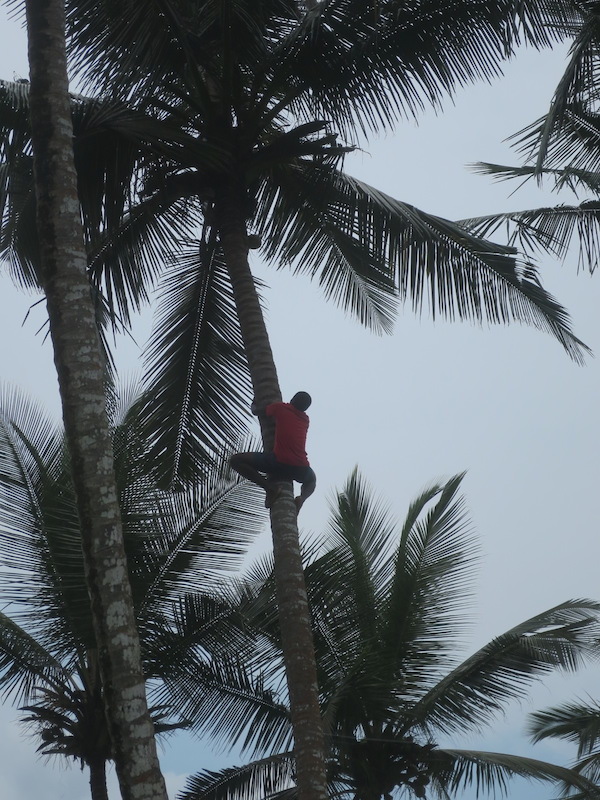
Climbing for coconuts
Magic on a plate
Chef
Plantation house

Saturday, December 10, 2016

Crossing the Equator: The Neptune Ceremony

One of the lively shipboard traditions is the ceremony when the ship crosses the Equator. This seafaring tradition goes back hundreds of years and is perfect for a sea day.

At noon, King Neptune (in our case, Queen Neptuna) followed by the captain and the POLLYWOGS, those who have not crossed the Equator by sea, march around the pool to the ceremonial site. Spectators or SHELLBACKS, those who have crossed the Equator by sea, cheer on the initiation of egg on the head for fertility, sand and sea, then kiss the fish. It’s all good fun.


Friday, December 9, 2016

Luanda, Angola


After two days at sea, we made it to Angola.

Africa is a continent of contradictions; and Luanda certainly exemplifies this. The country has immense oil and diamond riches and the people live in poverty. You see modern skyscrapers and people living in encampments on the beaches, in the parks and on the streets.


Angola has had a long relationship with Russia and Cuba. Their national flag certainly tells you that the communist have been influential. It’s a country that survived decades of civil war, and military control is pretty evident. We toured the city in a minibus caravan with a police escort. We got the distinct impression that it would not be a good idea to go touring on our own. Most of the pictures were taken from the bus window or the limited stops at the "pretty places", so we never had the chance to grab some good shots of the people or the poverty.

Skyline and beach 

Church built in 1664 still in use

How the people live
The women carry just about everything on their heads. Jim worked to get a shot of the woman carrying 3 dozen eggs, but didn't get it. 

Parliament
Angolan flag in background. Can you see the resemblance to the hammer & sickle?